Common Glow-worm Boiler Problems and What Usually Causes Them
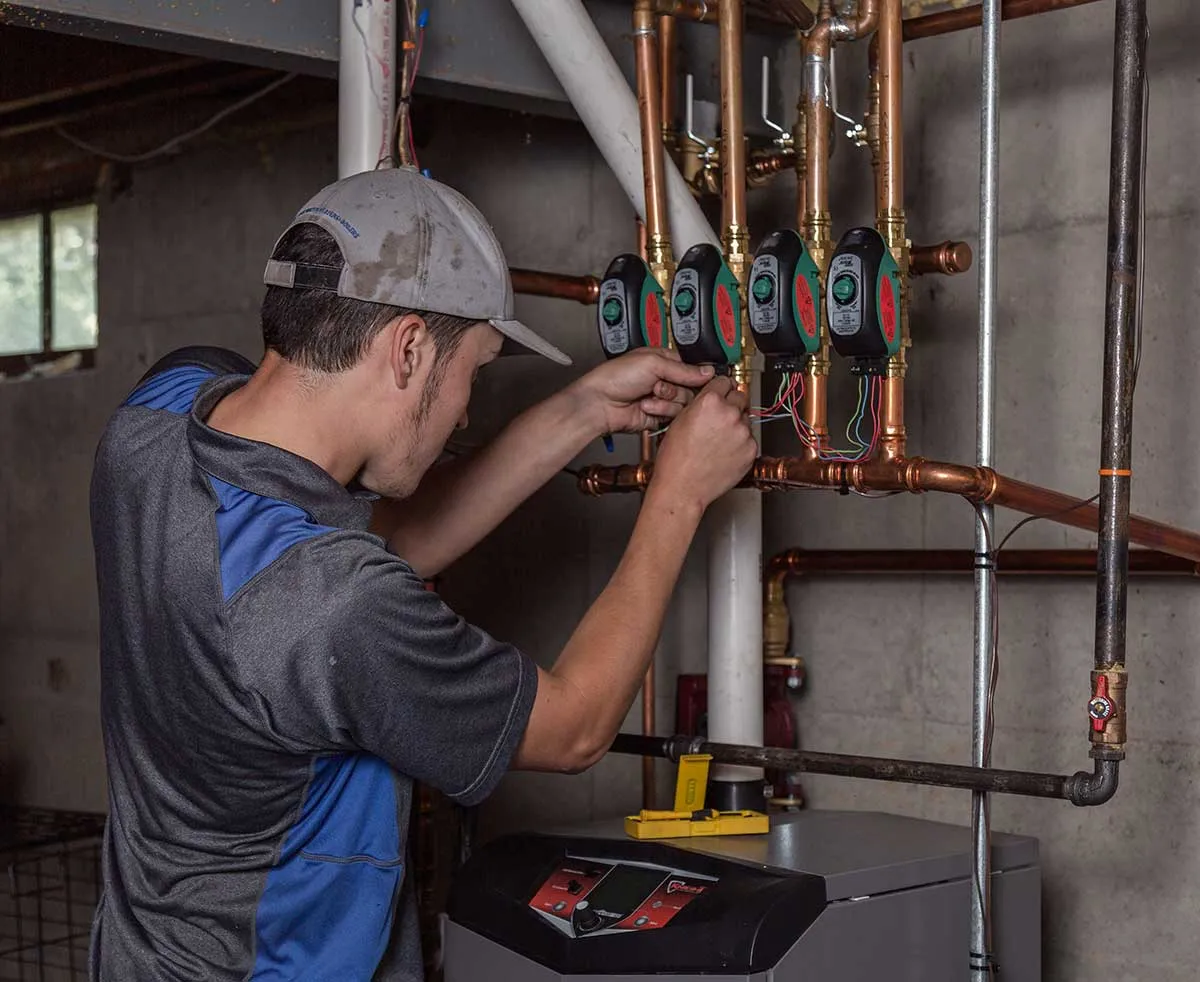
Most Glow-worm boiler problems fall into five groups: low pressure, failure to light, a frozen condensate pipe, circulation faults and a combi with no hot water. The fault code tells you which, and only a few checks are safe to do yourself.
The most common Glow-worm boiler problems are low water pressure (F22), failure to light (F1, F4, F28 and F29), a frozen or blocked condensate pipe in winter, circulation faults that cause overheating or kettling, and a combi that gives heating but no hot water. A few of these you can check safely at home: the pressure gauge, the gas supply and the outside condensate pipe. Everything inside the casing is work for a Gas Safe registered engineer. Here is how to tell the problems apart and when to stop trying.
What Are the Most Common Glow-worm Boiler Problems?
Most Glow-worm faults fall into five groups: pressure, ignition, condensate, circulation and hot water. The code on the display usually tells you which group you are dealing with.
Current Glow-worm boilers, including the Energy, Ultimate, Easicom and Flexicom ranges, show fault codes that start with F. Some older Betacom models flash the temperature digits or lights instead of showing a code, so check the manual for your model before reading anything into a flashing light. The model name is on the front panel or on the data badge, which is usually under the boiler or behind the front cover flap.
Glow-worm is part of the same manufacturer group as Vaillant, so any engineer who knows Vaillant boilers will know a Glow-worm well. Before you press reset, write the full code down. It can disappear once the boiler restarts, and it is the single most useful detail to give an engineer.
Why Does My Glow-worm Boiler Keep Losing Pressure?
If your Glow-worm shows F22 or the gauge keeps drifting below 1 bar, water is leaving the heating system. Topping up gets the boiler running, but it does not fix wherever the water is going.
With the heating off and the system cold, most Glow-worm combi and system boilers should read around 1 to 1.5 bar. Topping up through the filling loop is a job Glow-worm documents for homeowners, and it involves no gas work. The problem is needing to do it again and again. The usual causes are a small leak at a radiator valve or a joint under the floor, a pressure relief valve that lets water out through the copper pipe on the outside wall, or an expansion vessel that has lost its air charge. A reading that swings high when the heating is on and low when it cools points at the vessel. A slow, steady fall even with the heating off points more at a leak.
Our guide to what Glow-worm boiler pressure should be goes through the gauge readings, the top-up and the high-pressure side in more detail.
Why Won't My Glow-worm Boiler Light?
If the boiler clicks, tries to light and then locks out with F1, F4, F28 or F29, it is an ignition problem. The common causes are no gas reaching the boiler, a frozen or blocked condensate pipe, or a worn ignition electrode or flame sensing fault.
There are three things you can check safely. Make sure your gas hob or other gas appliances work, and that a prepayment meter has credit. Check that the gas isolation valve under the boiler has not been knocked. In freezing weather, look at the plastic condensate pipe where it leaves the house (more on that below). After those checks, reset once using the method in your manual.
If the code comes straight back, stop resetting. Our page on the Glow-worm F1 fault code explains how an engineer narrows it down to the electrode, the ignition lead, the gas valve or the board. If your boiler shows a mix of these codes, or locks out and restarts over and over, read why a Glow-worm boiler keeps locking out.
Why Does My Glow-worm Stop Working in Cold Weather?
A Glow-worm that works all year and then locks out on the first hard frost usually has a frozen condensate pipe. The acidic water the boiler produces cannot drain, it backs up inside the boiler, and the boiler shuts itself down.
Glow-worm boilers are condensing boilers, so they all have a plastic condensate pipe, and the part that runs outside is the part that freezes. Thawing the outside section with warm water or a warm cloth is a safe homeowner job. Use warm water, not boiling, because boiling water can crack the plastic. Then reset the boiler once.
If the pipe is not frozen but the boiler still behaves the same way, the pipe or the trap inside the boiler may be blocked with debris or sludge, which is a job for an engineer. A pipe that freezes every winter is also worth fixing properly: a long external run, a narrow pipe or no insulation are all things an engineer can change so it stops happening.
What Causes Overheating, Kettling or No Hot Water on a Glow-worm?
Overheating and a rumbling, kettle-like noise usually mean water is not moving through the boiler fast enough. On a Glow-worm combi, heating with no hot water, or hot water with no heating, usually points to the diverter valve.
For circulation problems, the usual causes are a pump that is sticking or wearing out, sludge narrowing the heat exchanger, air trapped after work on the radiators, low pressure, or too many radiator valves closed at once. Check the pressure, open several radiators, bleed any that are cold at the top, then reset once. If the noise or the lockout returns, stop and book a repair, because each restart heats the same trapped water again.
The diverter valve decides whether hot water goes to the radiators or to your taps. If it sticks, you get one and not the other, or radiators that warm up every time you run a hot tap. Before assuming that, check the hot water setting is turned up, the boiler is not in a heating-only mode, and the mains cold flow at the kitchen tap is normal, since a combi needs enough flow to fire for hot water. In London's hard water, hot water that is weak, swings between hot and cold or stops on a busy morning can also come from scale in the combi's plate heat exchanger.
What Do F61, F62, F63 and F13 Mean on a Glow-worm?
F61, F62 and F63 are circuit board faults, and F13 points to the main board or its wiring, or sometimes a temperature sensor. None of them has a safe home fix beyond checking the power.
If the display is completely blank, check the fused spur switch next to the boiler, the fuse inside it and your consumer unit before anything else. If a board code appears after a power cut, switching the boiler off at the spur for a minute and back on can clear it. If it returns, an engineer needs to test the board, the wiring and the parts the board controls. Water getting inside the casing is a common reason boards fail, so any leak should be found before a new board goes in, or the new one may fail the same way.
When Should You Call an Engineer, and Is a Glow-worm Worth Repairing?
Do the safe checks, reset once, and call an engineer if the same code comes back. Most Glow-worm faults come down to a single part and are worth repairing.
Call straight away, and do not reset, if you see soot or scorch marks around the boiler, the flame looks yellow or orange rather than blue, or you hear loud, continuous banging. If you smell gas, turn the supply off at the meter if you can, open windows, avoid electrical switches and ring the National Gas Emergency Service on 0800 111 999. Any work inside the boiler casing must by law be done by a Gas Safe registered engineer.
Repair is not always the right answer. On an old Glow-worm with a leaking heat exchanger, several major parts failing at once, or parts that are no longer made, a good engineer should tell you that plainly rather than keep patching it. When you contact us about a Glow-worm boiler repair in London, have the model name, the full fault code and whether you have already topped up or reset it. It helps us bring the right parts.
Frequently asked questions
Are Glow-worm boilers prone to problems?
No more than most modern combis. The faults we see on Glow-worm boilers are the ones every brand gets: pressure loss, ignition lockouts, frozen condensate pipes, pumps and diverter valves. How reliable one is depends much more on how it was installed, how clean the system water is and whether it is serviced every year.
How do I reset a Glow-worm boiler?
Most current Glow-worm boilers have a reset button on the front panel, described in the user manual. Check the pressure, the gas supply and the condensate pipe first, then reset once. If the same fault code comes back, stop resetting and book a Gas Safe registered engineer.
Where can I find what my Glow-worm fault code means?
The user manual for your model lists every code it can show, and the model name is on the front panel or data badge. Write the code down before you reset. The same code can mean slightly different things on older and newer ranges, so check against your exact model.